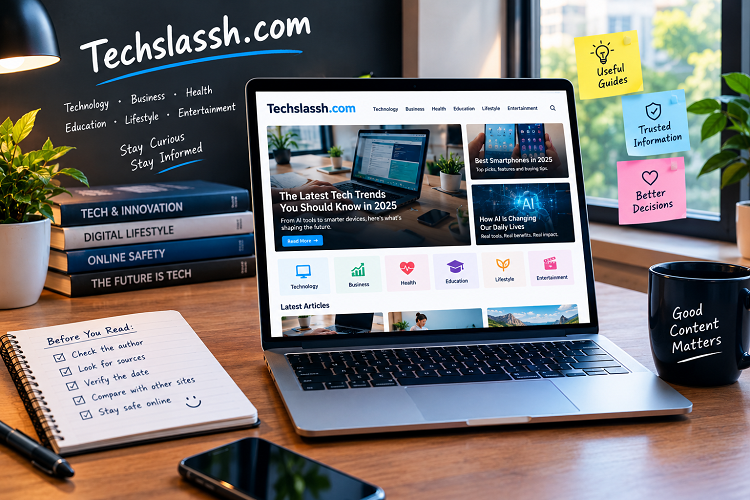

Finding reliable technology information online isn’t always easy. Some websites offer practical advice and clear explanations, while others leave readers searching for answers. Knowing how to distinguish between the two can save time and help you make better decisions. Techslassh.com is one website readers may encounter when exploring technology, software, digital tools, and other online topics. Whether you discovered it through Google, social media, or a recommendation, you may be wondering what it offers and whether its content is worth your time.
The website’s published descriptions indicate a broad editorial focus. Alongside technology, it covers subjects such as business, education, health, lifestyle, fashion, celebrity news, and entertainment. That range may appeal to readers who prefer exploring several topics in one place.
Still, a website’s stated purpose doesn’t automatically establish its credibility. Readers should consider the quality of its articles, the evidence behind its claims, its privacy practices, and the transparency of its editorial process.
This guide examines what Techslassh.com says about its content, how to evaluate its usefulness, and what to check before trusting its advice. It also offers practical steps for browsing safely and finding dependable technology information.
Also Read: TechyHitTools.org Guide
What Is Techslassh.com?
Techslassh.com is an online publishing website with a stated interest in technology and several general-interest subjects.
Its About page describes a range of categories, including technology, health, business, education, celebrity news, lifestyle, fashion, and entertainment. The website’s contact page highlights gadgets, software, artificial intelligence, and technological innovation.
Together, these descriptions suggest that Techslassh.com aims to reach a broad audience rather than focus exclusively on technical professionals.
For readers, that approach has potential advantages. Someone researching a digital tool might also find articles about business or everyday technology. However, broad coverage doesn’t necessarily mean every section offers the same depth or editorial expertise.
The best way to assess the website is to examine individual articles and determine whether they provide accurate, useful, and well-supported information.
Who Might Benefit From Techslassh.com?
The website’s stated subject areas may appeal to several groups:
- Everyday technology users looking for accessible explanations of software, gadgets, and digital trends.
- Students exploring technology concepts or general educational topics.
- Business readers interested in innovation, digital tools, and business developments.
- Technology enthusiasts who want to learn about AI, software, and consumer devices.
- General readers who enjoy browsing technology alongside lifestyle and entertainment content.
These are potential audiences based on the website’s published focus, not verified demographic findings.
What Topics Does Techslassh.com Cover?
Techslassh.com describes a varied content offering. Its technology-related subjects include gadgets, software, and artificial intelligence, while its broader categories cover business and lifestyle topics.
Here’s what readers can look for in each area.
1. Gadgets and Consumer Technology
Gadget content helps readers understand the devices they use every day. Articles in this category may discuss smartphones, laptops, accessories, device features, and emerging consumer technology.
Useful coverage should go beyond repeating manufacturer specifications. A good product article explains what those specifications mean in practice.
For example, a smartphone comparison should consider battery life, camera performance, software support, and price. Those details help readers decide whether an upgrade offers genuine value.
When researching a product, compare published specifications with the manufacturer’s official information. For performance claims, look for independent testing and clear evaluation methods.
2. Software and Digital Tools
Software guides can help readers choose applications, understand features, and solve common technical problems.
The most useful articles provide clear instructions, identify compatible operating systems, and explain any limitations. They also distinguish between free features and paid subscriptions.
Suppose you’re looking for a file-conversion tool. A reliable guide should explain supported formats, privacy considerations, pricing, and any restrictions on file size.
Before following a tutorial, check whether it matches your current software version. Older instructions may no longer reflect the latest interface or available features.
3. Artificial Intelligence
Artificial intelligence has become a major area of interest for people exploring productivity tools, automated workflows, and digital services.
AI coverage can help readers understand how these tools work and where they might prove useful. However, strong reporting should also explain their limitations.
For example, an AI writing assistant may help organize ideas or draft text. It may still produce incorrect information, overlook context, or mishandle sensitive data.
Readers should look for articles that explain practical applications without presenting marketing claims as established facts. Privacy, accuracy, pricing, and data retention deserve particular attention.
4. Business and Education
Business and education articles can introduce readers to digital workflows, online learning resources, and technology-driven changes.
Practical examples make this content more valuable. A useful article about business software, for instance, should explain which problems a tool solves, who benefits from it, and what it costs.
Educational content should identify reliable references and explain unfamiliar concepts clearly. Readers should also distinguish general guidance from advice that requires professional expertise.
5. Lifestyle and Entertainment
Techslassh.com’s published About page also lists lifestyle, fashion, celebrity, and entertainment content.
These categories may attract readers who want a broader mix of stories rather than technology news alone. However, the standards for evaluating each subject differ.
A technical tutorial needs accurate instructions. A celebrity profile requires reliable biographical information, while a health article needs credible medical evidence.
A website can cover many subjects successfully, but readers should assess the accuracy and depth of each article rather than assume consistent quality across every category.
How to Evaluate the Quality of Techslassh.com Articles
A professional-looking website can still publish outdated or poorly supported information. Before relying on an article, examine its sources, authorship, publication date, and practical value.
Check the Author’s Background
Look for a byline, author biography, relevant experience, and links to other published work.
A technical review becomes more convincing when the writer explains their testing process. A cybersecurity article should demonstrate a clear understanding of the risks it discusses.
An author’s name alone doesn’t establish expertise. Consider whether the person’s background and evidence support the claims they make.
Examine the Sources
Reliable articles give readers a way to verify important claims.
Depending on the subject, useful references include:
- Official manufacturer specifications and product documentation.
- Government cybersecurity advisories.
- Original research papers and technical reports.
- Independent product tests and established journalism.
- Developer announcements and software release notes.
If an article announces a new software feature, check the developer’s official website. If it discusses a security vulnerability, look for relevant advisories or technical documentation.
The stronger the claim, the more important independent verification becomes.
Check Publication and Update Dates
Technology information can become outdated quickly. Software interfaces change, subscriptions increase in price, and devices receive new features through updates.
Always check when an article was published and whether the author has updated it.
For a software tutorial, confirm that the instructions match your operating system and installed version. For a product recommendation, verify the current price and support period before buying.
Distinguish Facts From Opinions
Product reviews often mix measurable information with personal judgement.
A laptop’s weight is a specification. Describing its keyboard as comfortable is an opinion based on experience.
Both can help readers, but a good review explains the difference. Ideally, it provides testing details, relevant comparisons, and enough context for readers to reach their own conclusions.
Decide Whether the Article Actually Helps
An article’s length doesn’t determine its usefulness. The real question is whether it answers the reader’s question.
Look for direct explanations, practical examples, relevant limitations, and evidence that supports the main points.
If an article repeats broad claims without providing details, consult another source before acting on its advice.
Is Techslassh.com Safe to Visit?
Website safety involves more than whether a page opens without a browser warning.
You may want to know whether a connection is encrypted, whether a download contains malware, or whether the website handles personal information responsibly. These are separate questions and require different checks.
Techslassh.com has a published privacy policy that describes information the website may collect, including information supplied by visitors, device and browsing information, and cookies.
The existence of a privacy policy is useful because it gives readers a place to review the site’s stated practices. However, the policy alone doesn’t independently verify how those practices work in reality.
The same distinction applies to HTTPS. An encrypted connection helps protect data traveling between your browser and a website, but it doesn’t guarantee that the content or downloads are trustworthy.
Safety Checks Before Using Techslassh.com
A few straightforward precautions can reduce unnecessary risks.
- Verify the domain. Confirm that the address is exactly
techslassh.com. Similar-looking domains may belong to unrelated websites. - Check your browser’s security indicators. Make sure the connection uses HTTPS and that your browser doesn’t display a security warning.
- Avoid unexpected downloads. Don’t install unfamiliar applications or browser extensions simply because an article recommends them.
- Protect sensitive information. Avoid sharing passwords, payment details, or government identification unless you have a verified and necessary reason.
- Inspect external links. Check where a link leads before opening it, particularly if it directs you to an unfamiliar service.
- Use reputable security tools. If a URL looks suspicious, consult a recognized URL reputation service before proceeding.
These precautions apply to unfamiliar websites generally. They aren’t evidence that Techslassh.com has engaged in harmful activity.
Should You Share Personal Information?
Reading an article usually involves less risk than registering an account, submitting a form, or downloading software.
Before providing personal details, read the privacy policy and consider why the website needs the information. Be especially cautious if a page requests financial details or account credentials without a clear reason.
If a request seems unusual, stop and verify its legitimacy. Ordinary article reading shouldn’t require you to disclose sensitive information.
Safety assessment: The available information doesn’t support a blanket guarantee that every page, external link, or download associated with Techslassh.com is safe. Use standard security precautions and assess each request individually.
Pros and Cons of Techslassh.com
Every publishing website has strengths and limitations. Based on its stated subject areas and publicly described policies, here’s what readers should consider.
| Potential advantages | Limitations to consider |
|---|---|
| Covers several subjects in one place | Editorial depth may vary across categories |
| Includes technology-related content | Individual claims still require verification |
| Provides public About and Contact pages | Public pages don’t independently establish ownership |
| Publishes a Privacy Policy | A written policy doesn’t prove how every practice operates |
| May introduce readers to unfamiliar topics | Current article quality must be assessed individually |
These points describe the website’s stated scope and the limits of the available evidence. They shouldn’t be interpreted as independent proof of its overall editorial quality or safety.
Is a Multi-Topic Website Better Than a Specialist Publication?
That depends on what you need.
A general publishing website can offer an accessible introduction to an unfamiliar subject. Specialist publications may provide deeper analysis, hands-on testing, and more extensive technical coverage.
Imagine you’re researching a new productivity application. A general article may help you understand its purpose and main features. Before paying for a subscription, compare independent reviews, examine the provider’s pricing page, and check its privacy terms.
Using several sources gives you a more balanced view than relying on a single article.
Techslassh.com vs. Specialist Technology Websites
Different sources serve different purposes. Understanding those differences can make online research more efficient.
| Feature | Techslassh.com | Specialist tech publication | Official product website |
|---|---|---|---|
| Main purpose | Broad online publishing | In-depth technology coverage | Product information and support |
| Subject range | Multiple categories | Usually technology-focused | Specific product or service |
| Best use | Discovering topics | Reviews, comparisons, and analysis | Specifications and official instructions |
| Product testing | Verify individual articles | Look for published testing methods | Primarily provides manufacturer information |
| Editorial perspective | Assess article by article | Review editorial standards | Represents the product provider |
| Buying decisions | One possible source | Independent comparison | Confirm official specifications and pricing |
This is a comparison of publishing models, not a verified head-to-head assessment of article quality.
For the best results, use these sources together. Start with an accessible explanation, consult specialist reporting for deeper analysis, and confirm technical details with the official provider.
For cybersecurity questions, also consult relevant government advisories and trusted security organizations.
Expert Tips for Getting More Value From Techslassh.com
You don’t need to conduct an extensive investigation every time you read an article. A few practical habits can help you recognize useful information and avoid common mistakes.
1. Start With a Specific Question
Know what you want to learn before browsing.
If you’re researching AI writing software, for example, consider its features, accuracy, privacy practices, and price. A clear set of questions makes it easier to identify whether an article offers meaningful answers.
2. Verify Important Claims With Original Sources
Suppose an article states that a subscription costs $15 per month. Visit the provider’s official pricing page before making a purchase.
Prices, free trials, and included features can change. Third-party articles don’t always reflect the latest terms.
The same principle applies to product specifications, software compatibility, and new feature announcements.
3. Understand Product Recommendations
Check whether an article discloses affiliate links, sponsored placements, or products supplied for review.
These relationships don’t automatically make a recommendation unreliable. However, readers should understand whether the publisher might receive a financial benefit from a purchase.
Look for balanced coverage that discusses disadvantages, alternatives, and the intended audience.
4. Use Extra Caution With Health and Financial Content
Techslassh.com lists health and business among its subject areas. Some topics in these categories can affect important personal decisions.
For medical information, consult established medical organizations and qualified healthcare professionals. For investments or other financial decisions, review official disclosures and reliable financial sources.
Don’t rely on an unfamiliar website as your sole authority for medical treatment or financial advice.
5. Test Technical Instructions Carefully
Before following a tutorial, confirm that it matches your device, operating system, and software version.
Pay particular attention to instructions involving administrator permissions, system settings, command-line tools, or security controls.
Don’t run commands you don’t understand. If a step could delete files or change important settings, investigate its purpose before proceeding.
6. Maintain Good Digital Security Habits
Even a useful website can’t replace basic online security.
Use unique passwords, enable multifactor authentication where available, install software updates, and back up important files.
These habits reduce risk across the internet, regardless of which publishing website you visit.
(FAQs): About Techslassh.com
1. What is Techslassh.com?
Techslassh.com is an online publishing website that describes a broad editorial focus. Its stated categories include technology, health, business, education, celebrity news, lifestyle, fashion, and entertainment.
2. Is Techslassh.com a technology-only website?
No. Its published descriptions cover technology alongside several general-interest subjects. Readers looking for technical information should check the specific article and its supporting evidence.
3. Is Techslassh.com safe to use?
A blanket safety guarantee isn’t justified by the information available here. Check the domain, use HTTPS, avoid suspicious downloads, and don’t provide sensitive information without a clear reason.
4. Does Techslassh.com publish AI and software content?
The website’s Contact page identifies gadgets, software, AI, and technological innovation as areas of interest. However, the accuracy and usefulness of individual articles should be evaluated separately.
5. Can I trust Techslassh.com for technology advice?
Treat it as one potential source rather than an unquestionable authority. Check the author’s experience, publication date, supporting evidence, and consistency with official documentation or independent reporting.
6. Does Techslassh.com have a Privacy Policy?
Yes. Its published Privacy Policy describes information the website may collect, including visitor-provided information, device details, browsing information, and cookies. Read the policy directly to understand its stated practices.
7. Who owns Techslassh.com?
The available public descriptions don’t independently establish the identity of the website’s owner. Avoid treating unverified names or third-party claims as confirmed ownership information.
8. Is Techslassh.com useful for beginners?
It may help beginners explore general technology topics and other subjects covered by the website. Look for articles that explain unfamiliar terms, provide practical examples, and link to reliable sources.
9. Can I rely on Techslassh.com for product reviews?
Use its reviews as one input when comparing products. Look for hands-on testing, transparent evaluation criteria, balanced comparisons, and disclosures about affiliate relationships. Confirm specifications and prices with official providers.
10. How can I tell whether a Techslassh.com article is up to date?
Check the publication and update dates, then compare the information with current official documentation. For software guides, make sure the instructions match your operating system and installed version.
Conclusion
Techslassh.com presents itself as a multi-topic publishing website covering technology, gadgets, software, AI, and a range of general-interest subjects. Its public pages offer a starting point for understanding its stated purpose and policies.
However, a website’s description is only part of the credibility question. The real value lies in the accuracy of its articles, the quality of its evidence, and the transparency of its editorial practices.
For everyday research, use Techslassh.com to explore topics and discover useful information. Then verify important claims through official documentation, specialist reporting, and other reliable sources. Before downloading files or sharing personal information, take the time to assess the risks.
Ultimately, Techslassh.com may be a useful starting point for online research, but readers should judge its content on its merits. Clear sourcing, accurate information, relevant expertise, and responsible security practices matter far more than a website’s appearance or publishing claims.


Pingback: Kongotech.org Guide: Features, Benefits & Safety (2026)